Glosso Studio
A language course that grades your pronunciation one sound at a time. Open source, free for everyone with no paid tier, funded by donations. Scoring runs on the server or, optionally, on your phone.
- Role
- Side project · product, engineering and design
- Stack
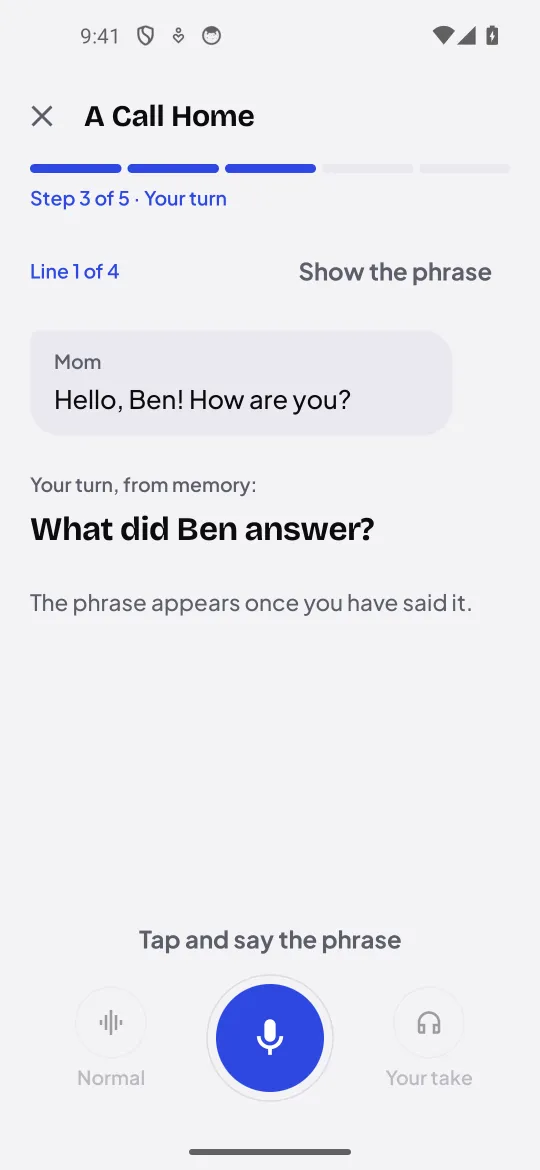
- AGPL-3.0
- open source: app, engine and server, all public
- ~342 MB
- optional on-device model, works offline
- ~130
- downloads on Google Play, around 30 monthly users
Most pronunciation apps push your speech through speech-to-text and tell you whether the words matched. That says almost nothing about how you sound. Glosso gives a verdict on each individual sound: which phonemes you hit, which drifted, and where inside the word the problem is.
It runs on Android and in the browser as an installable web app, with courses in English (British or American), French, German and Russian. It’s open source and free for everyone: no paid tier, no ads, funded by voluntary donations.
What it does
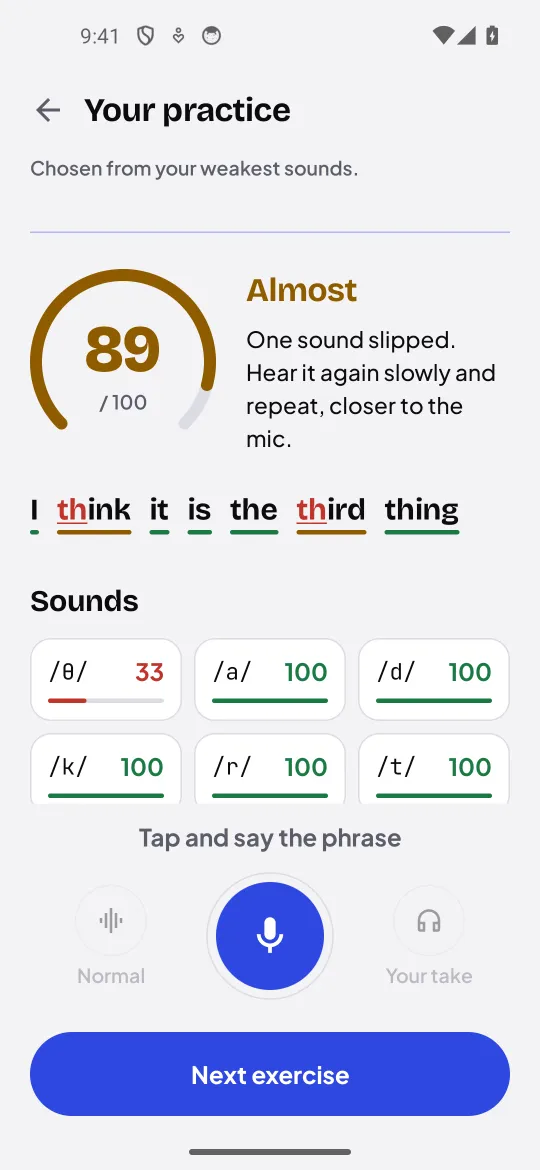
- Records a sentence and scores each phoneme on its own.
- Names the sound that slipped: for example, /t/ where the word needed /θ/.
- Shows the IPA of what it heard, next to a reference pronunciation.
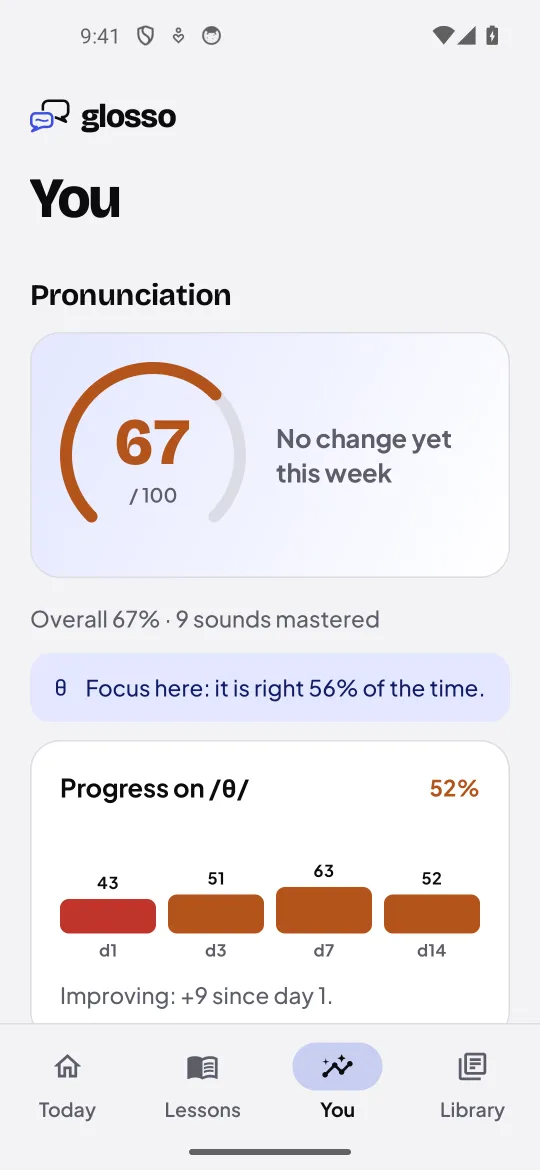
- Builds the next drill from your own errors and tracks each sound over time.
Where scoring runs
- Cloud by default. A normal install sends the recording over HTTPS to Glosso’s own server, where it is scored in memory and discarded as soon as the request ends. It is never stored, sold or used to train models.
- Optional on-device. Settings offers a one-time download of an acoustic model (about 342 MB). With it installed, scoring runs entirely on the phone and works offline. Delete it any time to go back to cloud scoring.
There is no mandatory account and no sign-up wall: progress stays on the device. No advertising or third-party tracking SDKs are in the build.
The app does send first-party usage statistics to the same server (screens opened, lessons finished, errors), linked to a random installation id, never to your name or email, and never your audio or anything you type. They’re on by default, the app says so when you start, and you can turn them off and delete them in Settings.
Limits
If the recording has no usable speech, or is too noisy or too quiet, Glosso says the attempt could not be evaluated instead of showing 0/100. The score is an estimate, not a certificate: even native speakers don’t always get the top score, and that’s one of the things I’m still improving.
Stack
One Kotlin Multiplatform engine does the phonetics, shared between the Android app and the scoring service so both paths agree. Compose Multiplatform for the app, shared by Android and the WebAssembly web app. ONNX Runtime with a wav2vec2 acoustic model for inference, Ktor for the service. Android 8.0 or newer.
Where it is now
Glosso is in a stable phase. Instead of adding features, the work goes into the pronunciation engine and into new languages, one at a time. I wrote about how it got here in What I learned building an app that listens to how you pronounce.
Open source
Glosso is free software under the GNU AGPL. The app, the phonetic engine and the server are all public, so anyone can read how a score is computed, check what the app sends, and run their own server: the repository ships a Docker setup, and the app can point at any server from Settings. An F-Droid build leaves out every Google library.
There is no paid tier and donating unlocks nothing; donations pay for the servers, recorded audio for new lessons and time for the iOS app.
Glosso grew out of an earlier offline prototype, Glosso Studio, which is open source too.
Drafted with AI, edited by hand. I publish it when it sounds like me.